A habit needs time
In the study by Lally et al., it typically took about 66 days for a daily action to become automatic, but anywhere from 18 to 254 days for different people. The study was small and has not been replicated yet.
Week 4 of 8 on the suggested path
I pick something that takes a minute a day, so small I can manage it even on a hard day.
Opens the app and offers this topic first. No account; you confirm with one tap.
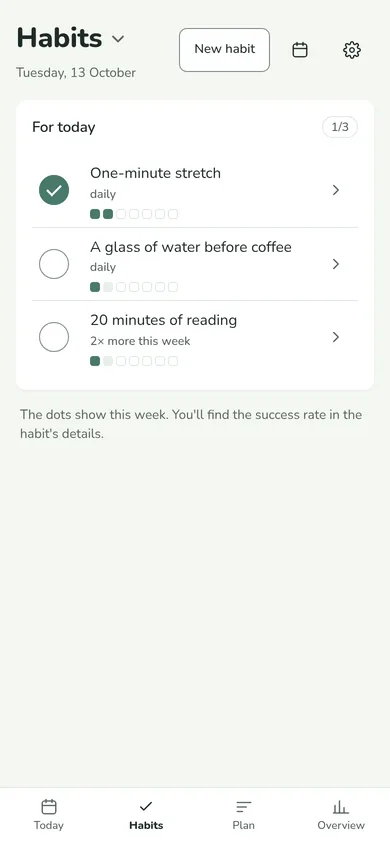
A few squats, a glass of water, one page of a book. In the Habits tab I make it a habit and tie it to something I do anyway, like “after my morning coffee”. I can set a reminder for a time when it makes sense.
Days in a row are not counted. The success rate only counts finished weeks and months, so a week in progress never haunts me and a missed day spoils nothing.
Only what the sources really say. The effects are often small, but real.
In the study by Lally et al., it typically took about 66 days for a daily action to become automatic, but anywhere from 18 to 254 days for different people. The study was small and has not been replicated yet.
In the same study, missing a single day did not really get in the way of forming the habit. That is why the app doesn’t count days in a row.
I pick one thing that takes a minute, tie it to something I do every day, and do it once today.
Opens the app and offers this topic first. No account; you confirm with one tap.
Inspired by Tomáš Baťa. Habits in three sizes, a minute a day, twenty minutes three times a week and an hour once a month, come from Baťa’s approach to working on yourself. That a minute is enough to start is his idea, not a research finding.