A tested questionnaire
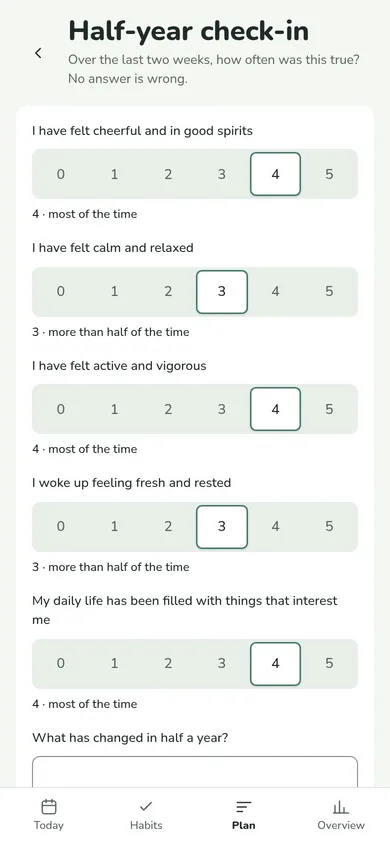
The questions come from the WHO-5 questionnaire. A systematic review of 213 studies confirmed that it measures well-being reliably and picks up changes.
Week 8 of 8 on the suggested path
Once every half year I pause, answer five questions on well-being and look three years ahead.
Opens the app and offers this topic first. No account; you confirm with one tap.
Five short questions about how I’ve felt over the last two weeks, each answered from 0 to 5. No answer is wrong. Next time I’ll see the result next to today’s.
In the Plan tab, on the Years card, I write where I want to be in three years. A few sentences are enough, and I can change them at every check-in. Only I see the answers.
Only what the sources really say. The effects are often small, but real.
The questions come from the WHO-5 questionnaire. A systematic review of 213 studies confirmed that it measures well-being reliably and picks up changes.
The same review describes the WHO-5 as a sensitive tool for spotting possible depression, not as a diagnosis. If difficulties persist, it’s good to see a professional.
In Plan, on the Years card, I write one sentence: where I want to be in three years.
Opens the app and offers this topic first. No account; you confirm with one tap.
Inspired by Tomáš Baťa. According to the sources, Baťa’s approach included a three-year transformation programme and, from 1925, regular half-yearly visits to a psychologist. The app takes the rhythm from it: pause once every half year.