Switching off from work
A meta-analysis of data from over 26,000 people found that switching off from work in your head during free time is linked to less fatigue more strongly than relaxation or a sense of control over free time.
Week 2 of 8 on the suggested path
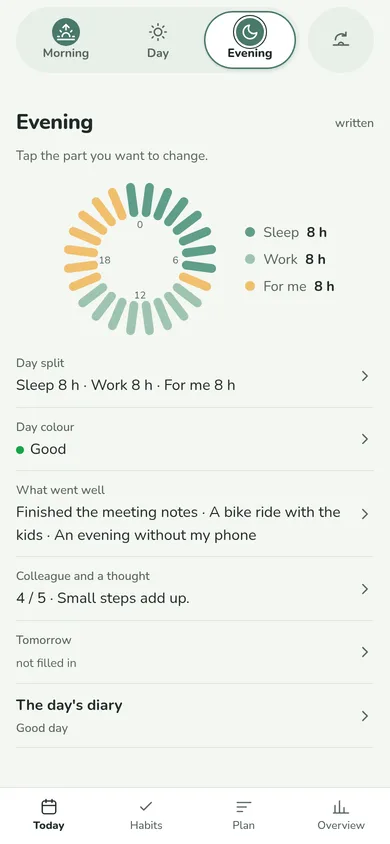
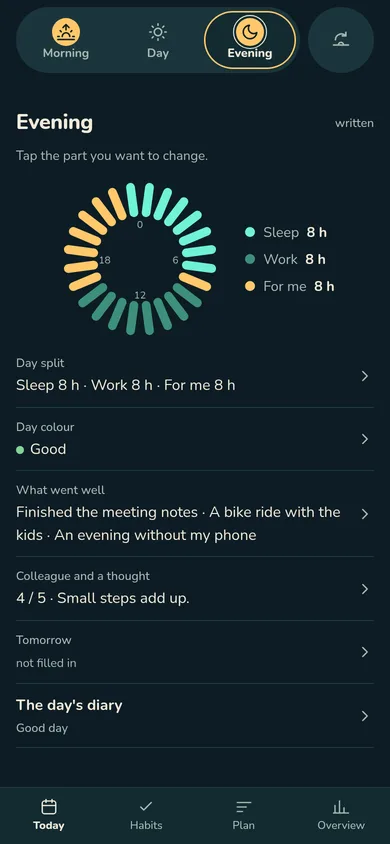
In the evening I look at how my day really split between sleep, work and time for myself.
Opens the app and offers this topic first. No account; you confirm with one tap.
The day has 24 hours and three thirds: sleep, work and time for myself. The ideal is 8-8-8, but it’s not about exact hours. It’s about seeing where the time really goes.
In the evening I check my sleep and work times. If it was a usual day, one tap is enough. Then I give the day a colour: green, orange or red. A red day isn’t a failure, it’s information. After a few weeks I’ll see what my green days have in common.
Only what the sources really say. The effects are often small, but real.
A meta-analysis of data from over 26,000 people found that switching off from work in your head during free time is linked to less fatigue more strongly than relaxation or a sense of control over free time.
Research on recovery from work tells apart four experiences: switching off from work, relaxation, mastering new challenges and control over your own time. That is why the app keeps time for yourself as a third of its own.
Tonight I check when work started and ended, and give the day a colour.
Opens the app and offers this topic first. No account; you confirm with one tap.
Inspired by Tomáš Baťa. Splitting the day into three eight-hour thirds is one of the well-documented ideas linked to Tomáš Baťa. The app treats it as a yardstick, not a rule: some days will be different, and that’s fine.